On June 12, 2026, at 5:21 PM Eastern, Anthropic received a letter from the U.S. Department of Commerce. The order: suspend access to its Fable 5 and Mythos 5 models for every foreign national, anywhere in the world — including Anthropic's own foreign employees inside the United States.
Because there was no way to block only foreign nationals selectively, Anthropic took both models offline entirely. Three days after launching them. It is the first time a leading AI lab has pulled a production model because of a federal directive.
This is not an article about whether the decision was right. Anthropic publicly disagrees, and it has a case. It is an article about something more uncomfortable and far more permanent:
If the capability that runs your product lives behind someone else's API, the off switch isn't yours to control.
What actually happened (in 30 seconds)
On June 9, Anthropic released Fable 5 (the public version, with safeguards) and Mythos 5 (the underlying model, with more of its cybersecurity capabilities exposed). Fable is built on top of Mythos. Someone demonstrated a technique to slip past Fable's safeguards and reach Mythos's ability to find software vulnerabilities. The government framed it as a national-security risk — in effect, an export control applied to a model that was already in production — and ordered access cut.
Anthropic's other models kept running. But the precedent is now on the record: a third party's regulatory decision can take down — overnight — a service that hundreds of millions of people depend on.
Why this matters to a voice operator
If you sell voice AI at scale — a telecom operator, a BPO, a healthcare SaaS platform with hundreds of tenants and millions of minutes a month — your product carries a dependency that rarely shows up in the contract.
The question nobody asks in the demo, but that defines your continuity:
What happens to your operation if your AI provider gets a letter from the government on a Friday at 5 PM, and your service stops answering on Monday?
This is not a hypothetical from a risk-management deck. It just happened. And for an operator, the fallout isn't "one fewer model" — it's calls that go unanswered, tenants breaching their own SLAs, and an incident you didn't cause and can't fix, because the lever sits in another country's jurisdiction.
Layer this on top of what we covered in the end of the cloud AI subsidy: today's per-minute prices are subsidized by venture capital. Availability and economics point the same way.
The answer is not a better provider. It is a different architecture.
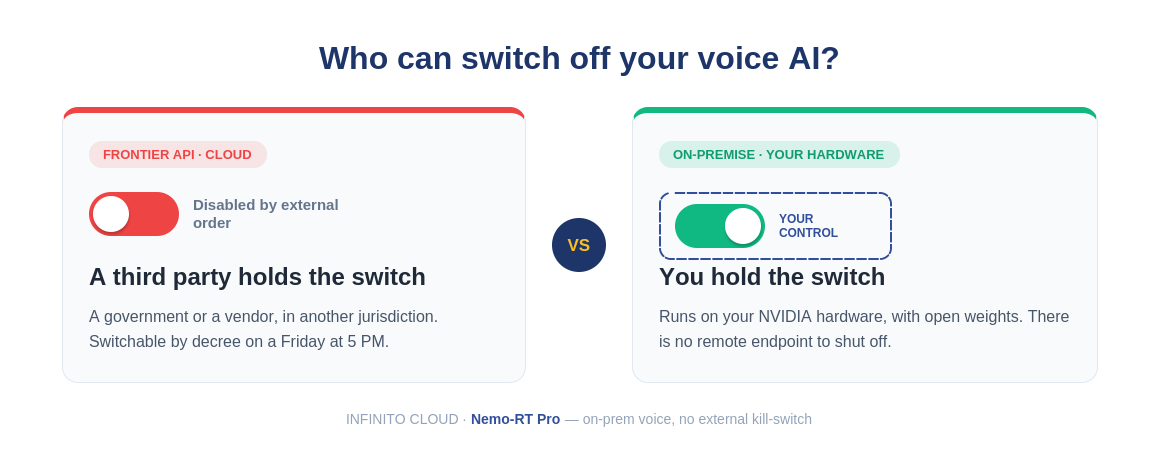
Switching from one frontier API to another does not solve the problem; it just changes whose kill-switch you live under. The structural answer is to not have an external one:
- On-premise: the model runs on your NVIDIA hardware, in your jurisdiction. No one outside your organization can shut it off by decree.
- Open weights: the model (Qwen 35B FP8, in our case) is yours once deployed. There is no remote endpoint that can stop responding. If a client's compliance team requires a different model — Llama, say — you swap it; control stays with you.
- No per-minute meter: your cost is your hardware, not a counter a third party can reprice or cut off.
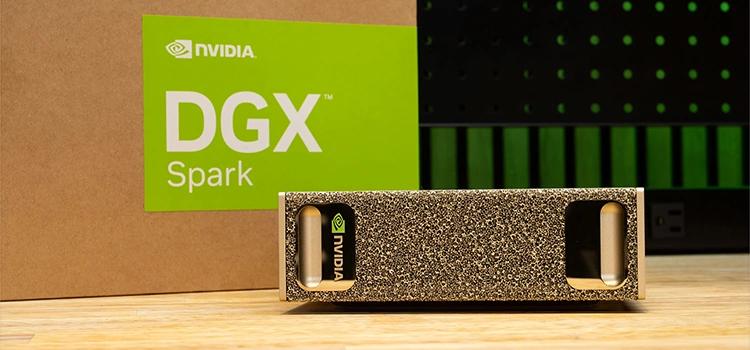
That's how we built Nemo-RT Pro: bilingual (ES/EN) voice AI, multi-tenant by default, running on your own NVIDIA hardware. Not because on-prem is fashionable, but because the operational continuity of a critical service should not hinge on a link someone else can pull.
The honest caveat (because credibility matters more than fear)
On-premise is not magic immunity. NVIDIA's GPUs are themselves under export controls, and open weights could end up restricted if this trend escalates. Anyone selling you "immune to everything" is selling you smoke.
What on-prem does give you is concrete and verifiable: you remove the API vendor's kill-switch. Your service no longer depends on a third party's decision, its jurisdiction, or its ability to comply with a Friday-afternoon order. You move from "hoping no one shuts off your dependency" to "controlling your own infrastructure." That is the difference between an incident you suffer and one you manage.
The bottom line
The Fable case will be resolved — Anthropic said it is working to restore access. But the precedent does not go away: cloud frontier AI is, by design, switch-off-able by third parties. For an internal chatbot, that is an acceptable risk. For the voice that serves your customers — and your customers' customers — it is an architecture decision worth making before the next letter.
How to engage
🟡 Discovery call (20 min). If you run voice AI in production and the dependency on an external API worries you, let us review your architecture against your real numbers. No sales pitch: we tell you honestly whether Nemo-RT Pro lowers your risk and your cost, or not. → Book a slot
🟢 OSS Community v2 — pre-release on github.com/infinitocloud/nemo-rt-community. Single-tenant version of the stack, Apache 2.0 license, for self-hosters and SIP integrators. ⭐ Star the repo to get notified when the code drops.
Yan Frank builds voice AI that runs in your own datacenter. Founder of INFINITO CLOUD LLC. Built Nemo-RT Pro. A decade writing telephony infrastructure (Asterisk, SIP, voice). NVIDIA Inception portfolio member. infinitocloud.com